

How Long Should I Study for the SAT?
If you’re planning to take the SAT, one of the first questions that probably comes to mind is: How long should I study for the SAT? And honestly, that’s a smart question because your timeline can make a huge difference in your final score.
The good news is that there’s no single “perfect” answer. Your ideal study time depends on your current level, your target score, and how consistent you are with practice.
Let’s break it down in a simple and realistic way so you can plan better without stress.
What is the SAT?
The SAT is a standardized exam widely used for college admissions, especially in the United States. It tests a student’s skills in reading, writing, and math to measure college readiness. If you want a complete overview of the exam, you can check this detailed SAT Exam Guide.
The exam is now fully digital and is designed to check how well students can solve problems, understand passages, and apply concepts under timed conditions.
Why the SAT is Important
The SAT is important because a strong score can increase your chances of getting into good universities and earning scholarships. Here’s why many students take the SAT:
Helps universities compare students fairly
Improves college admission opportunities
Can help you qualify for scholarships
Strengthens your academic profile
Opens doors to international universities
A good SAT score can sometimes make up for weaker areas in an application and help students stand out during competitive admissions.
First: Take a Baseline Diagnostic
Before making your SAT study plan, take an official SAT diagnostic test under real exam timing. This helps you understand your current score and shows how much you need to improve. It also helps you find your weak and strong areas.
Without a baseline score, it is hard to know how long you should study for the SAT. If your target score is close to your current score, you may need less study time. If the gap is bigger, you may need more months of preparation. A baseline test helps you create a smarter and more realistic SAT study schedule.
The Simple Formula: Target Score – Current Score = Study Hours
One of the easiest ways to plan your SAT preparation is by using a simple formula:
Your Target Score – Current Score = Estimated Study Hours
For example:
Current Score: 1200
Target Score: 1400
Difference: 200 points
This usually means you may need around 200–240 hours of focused preparation, depending on your learning speed and consistency.
This is often called the “120-Hour Rule.” On average, students need about 120 hours of quality preparation to improve their score by 100–200 points. However, the keyword here is quality. Just studying for long hours without focus usually does not help much.
To better understand how SAT scores work, you can also read this detailed guide on the SAT scoring system: Digital SAT Scoring System Guide
How Long Should I Study for the SAT in General?
Before we jump into scoring goals, let’s understand the general idea first. Most students need between 2 to 4 months of focused SAT preparation. This timeline works well if you study consistently and not just randomly before the exam.
Here’s a simple breakdown:
Light improvement (100–150 points increase): 4–6 weeks
Moderate improvement (200–300 points increase): 2–3 months
High improvement (300–500+ points increase): 3–6 months
The key is not just time, but how effectively you use that time. Studying for 4 months without structure won’t help as much as focused 2-month preparation.
If you want extra tips on getting a higher score on your first try, check out this helpful guide on How to Maximize Your SAT Score in One Attempt.
How Long Should I Study for the SAT to Get a 1500?
Now let’s talk about a high but achievable target = 1500 on the SAT.
If you’re starting around an average score range (1100–1300), getting to 1500 usually takes 2.5 to 4 months of serious preparation. But if you’re already scoring 1400+, you might reach 1500 in just 3 to 6 weeks with focused practice.
To reach 1500, your study hours should include:
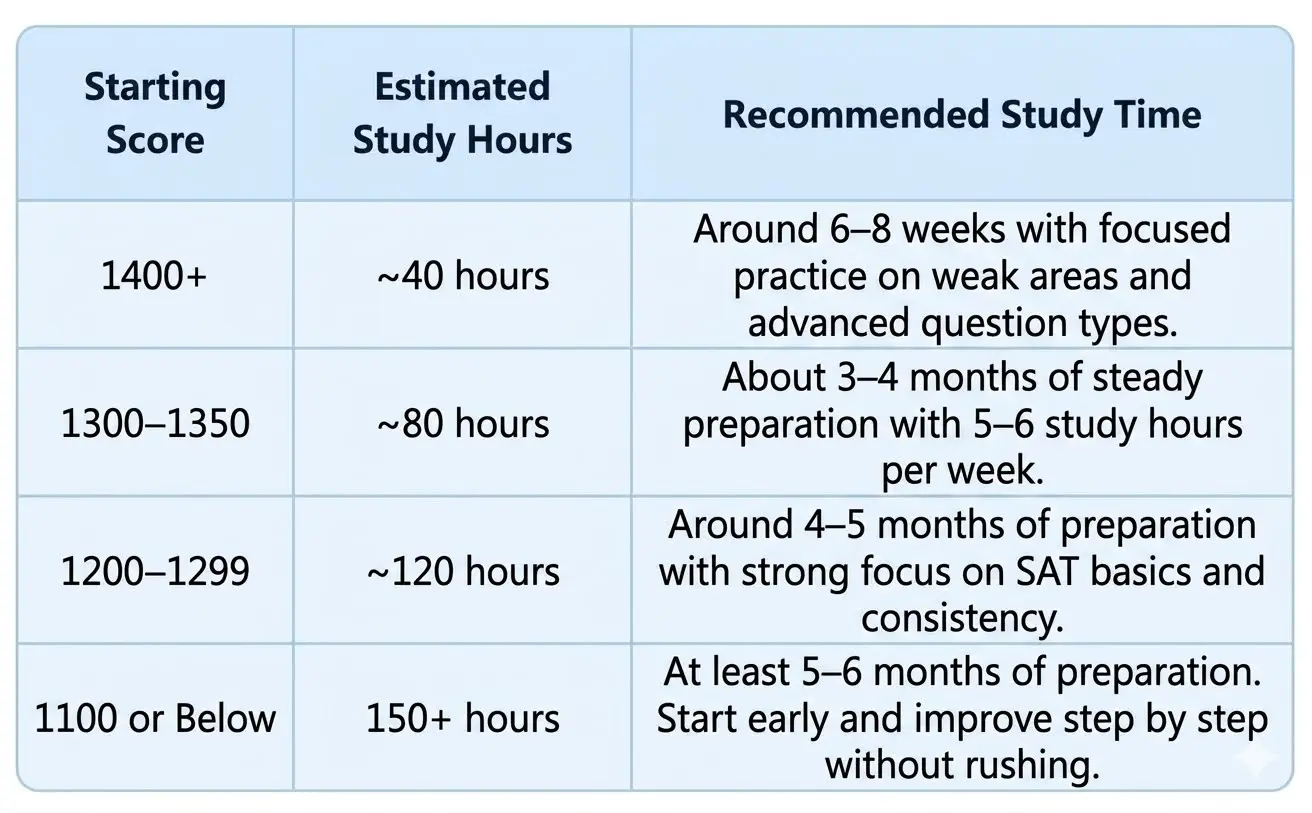
To reach 1500, your study plan should include:
Daily practice (at least 2–3 hours)
Strong focus on weak areas (Math or English)
Timed full-length practice tests every week
Deep review of mistakes (this is very important)
The students who reach 1500 don’t just study more, they study strategically. They understand patterns, timing, and question tricks.
So when you ask how long you should study for the SAT to get a 1500, the real answer is: long enough to master accuracy and speed, not just content.
How Long Should I Study for the SAT to Get a 1600?
A 1600 is the perfect SAT score, and yes it’s rare, but not impossible.
If your goal is perfection, expect a preparation timeline of 3 to 6 months or more, depending on your starting point. This level requires near-perfect accuracy in both Math and Reading/Writing sections.
To reach 1600, your study hours should include:
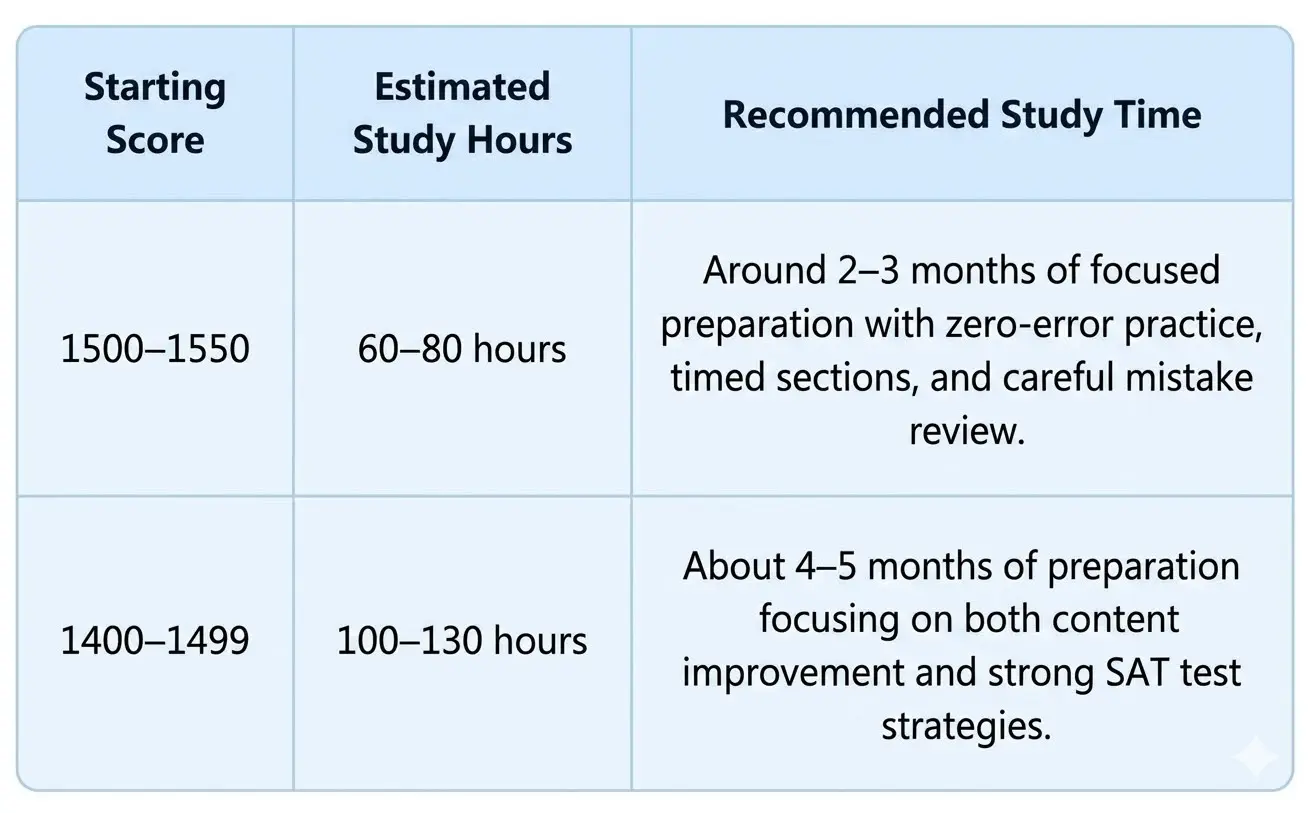
To reach 1600, your study plan should include:
Study 3–5 hours daily with full focus
Take full-length official practice tests regularly
Analyze every single mistake in detail
Strengthen mental stamina for long test sessions
Practice under strict timed conditions
At this level, even small mistakes matter. So preparation is not just about studying harder, it’s about being extremely precise.
So if your question is how long should I study for the SAT to get a 1600, the honest answer is: as long as it takes to eliminate careless errors and reach consistent perfection.
When Should You Start Studying for the SAT?
This is one of the most important questions students often ignore: “How Long Before the SAT Should You Start Studying?”
Starting early gives you a huge advantage. Ideally, you should start studying at least 3 to 6 months before your SAT exam.
Why so early? Because SAT success is not just about memorizing, it’s about building skills like:
Reading speed and comprehension
Problem-solving under time pressure
Pattern recognition in math questions
Test endurance
If you start early, you can:
Learn slowly without pressure
Practice more mock tests
Fix weak areas gradually
Avoid last-minute stress
If you start late (like 3–4 weeks before the exam), you’ll mostly be in panic mode, which affects performance. That’s why start at least 3 months before your SAT exam.
A Simple Timeline Table for Any Goal
Here’s a quick cheat sheet. Find your current score and target, then see what most students need.
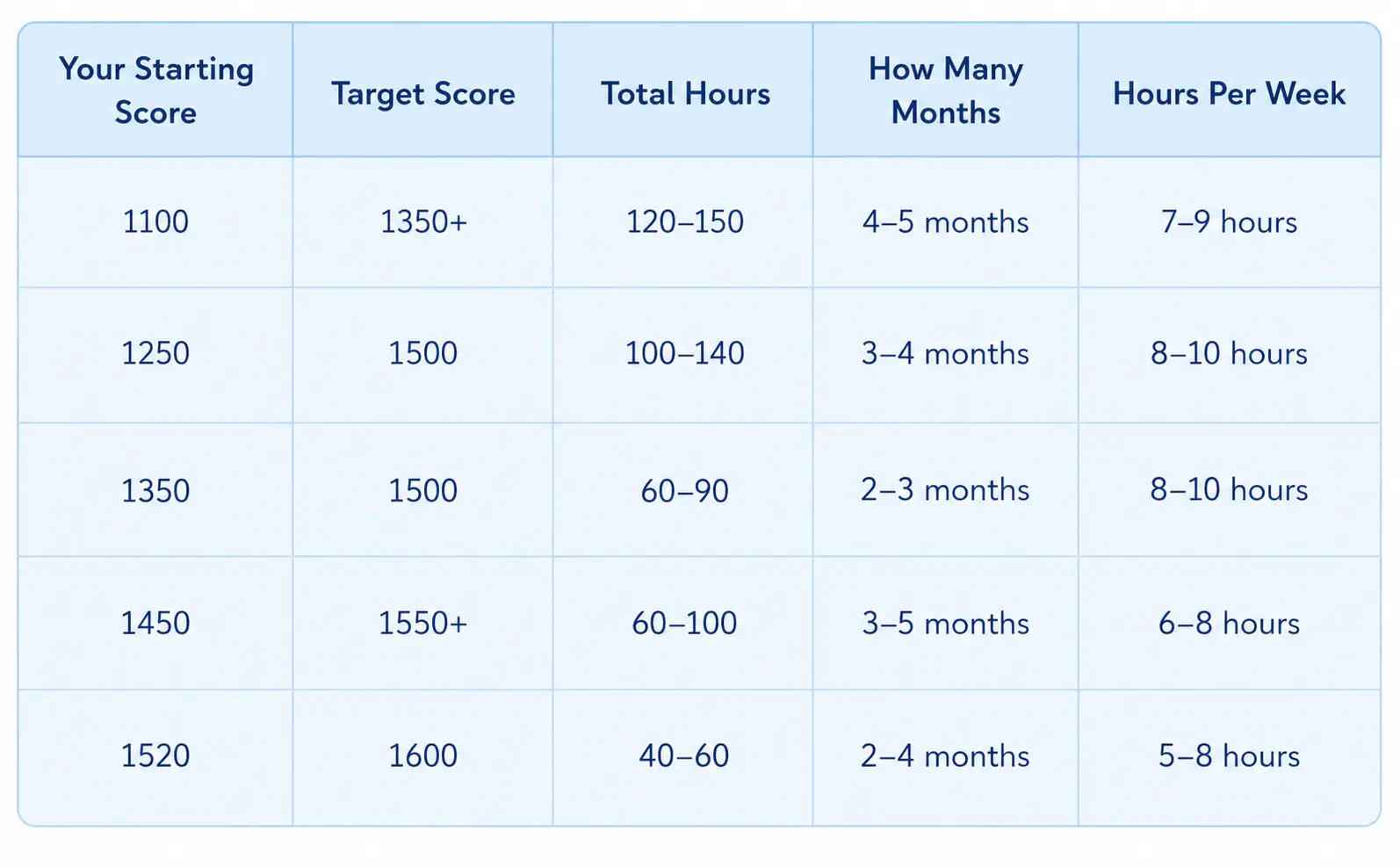
Use this as a starting point, not a rule carved in stone. Some people learn faster. Some need more repetition. That’s totally normal.
What Affects How Long You Need to Study?
Not everyone needs the same amount of time. Your study duration depends on a few key factors:
1. Your starting score: If you’re already close to your goal, you need less time. If not, expect a longer journey.
2. Study consistency: Studying 1 hour daily for 3 months is better than 10 hours once a week.
3. Learning speed: Some students pick up patterns faster, especially in math.
4. Quality of practice: Using real SAT questions and reviewing mistakes matters more than just solving random problems.
If you are planning to retake the SAT, this guide may also help you create a better strategy: SAT Retake Strategy Guide
Why Many Students Waste Study Time
Many students study for months but still do not see much improvement in their SAT scores. The main reason is that they study without a proper plan or strategy. Avoiding these mistakes can make even a short study period highly effective.
Studying without a plan
Ignoring timed practice
Not reviewing mistakes
Only reading theory, not practicing questions
Getting guidance and choosing the right learning support can make a big difference. You can also read this helpful guide: How to Choose the Right Tutoring Program for Your Child
How to Make Your Study Hours Count
Hours alone don't move your score; it does when you use your hours right. Here's what the research and top tutors consistently recommend:
Take full-length, timed practice tests every 2–3 weeks. Simulating real conditions is irreplaceable.
Do a detailed review after every practice test — understand exactly why each wrong answer was wrong, not just the right answer.
Focus 70% of your time on your weakest section. Gains there are faster and bigger than polishing your strong section.
Use College Board materials (Nobin Digital SAT Essentials) — they're the closest to real test content.
Study in shorter, focused sessions (45–60 min) rather than exhausting 3-hour marathons.
Track your error patterns. Most students make the same 5–10 mistakes repeatedly — fix those specifically.
Sample Weekly Schedule for a 3-Month SAT Study Plan to Get 1500
Getting a 1500 on the SAT requires consistency, smart practice, and good time management. A structured weekly routine can help you improve faster without feeling overwhelmed.
Monday: Advanced SAT Math practice + review mistakes (2 hours)
Tuesday: Reading comprehension and grammar practice (2 hours)
Wednesday: Focus on weak areas and difficult question types (1.5–2 hours)
Thursday: Timed SAT Math module practice (2 hours)
Friday: Timed Reading and Writing practice + vocabulary review (2 hours)
Saturday: Full-length digital SAT practice test under real exam conditions (3–4 hours)
Sunday: Deep review of mistakes, strategy improvement, and light revision (2 hours)
This schedule gives around 14–16 study hours per week, which is ideal for students aiming for a 1500 SAT score in 3 months.
Recommended Resources to Get a High Score in the SAT
Using the right SAT resources can make your preparation easier and more effective. Good study materials help you understand the exam pattern, practice real questions, and improve your weak areas faster.
Official College Board SAT Practice Tests
Khan Academy SAT Preparation
SAT Question Bank and Mock Tests
Digital SAT Practice Apps
Vocabulary Building Apps and Flashcards
YouTube SAT Math and English Tutorials
Online SAT Courses and Mentorship Programs
Daily Reading Practice from Articles and Journals
For better results, focus more on official SAT-style questions and timed practice instead of random study materials.
Boost Your SAT Preparation with Nobin
If you’re serious about improving your SAT score, structured learning can make a huge difference. That’s where Nobin comes in.
Nobin is designed to help students prepare smarter with organized SAT courses, practice materials, and guided learning paths. Instead of guessing what to study next, you get a clear roadmap that saves time and reduces confusion.
Whether you’re aiming for a 1200, 1500, or even 1600, Nobin helps you stay on track with focused lessons and consistent practice support. It’s a helpful option for students who want structure without feeling overwhelmed.
Conclusion
So, how long should you study for the SAT? The honest answer is: it depends on your goal, starting level, and consistency. Most students need 2 to 6 months for solid improvement, while higher scores like 1500 or 1600 require more focused preparation.
The earlier you start and the smarter you study, the better your results will be. Instead of rushing, build a steady plan and stick to it, you’ll see real progress over time.