


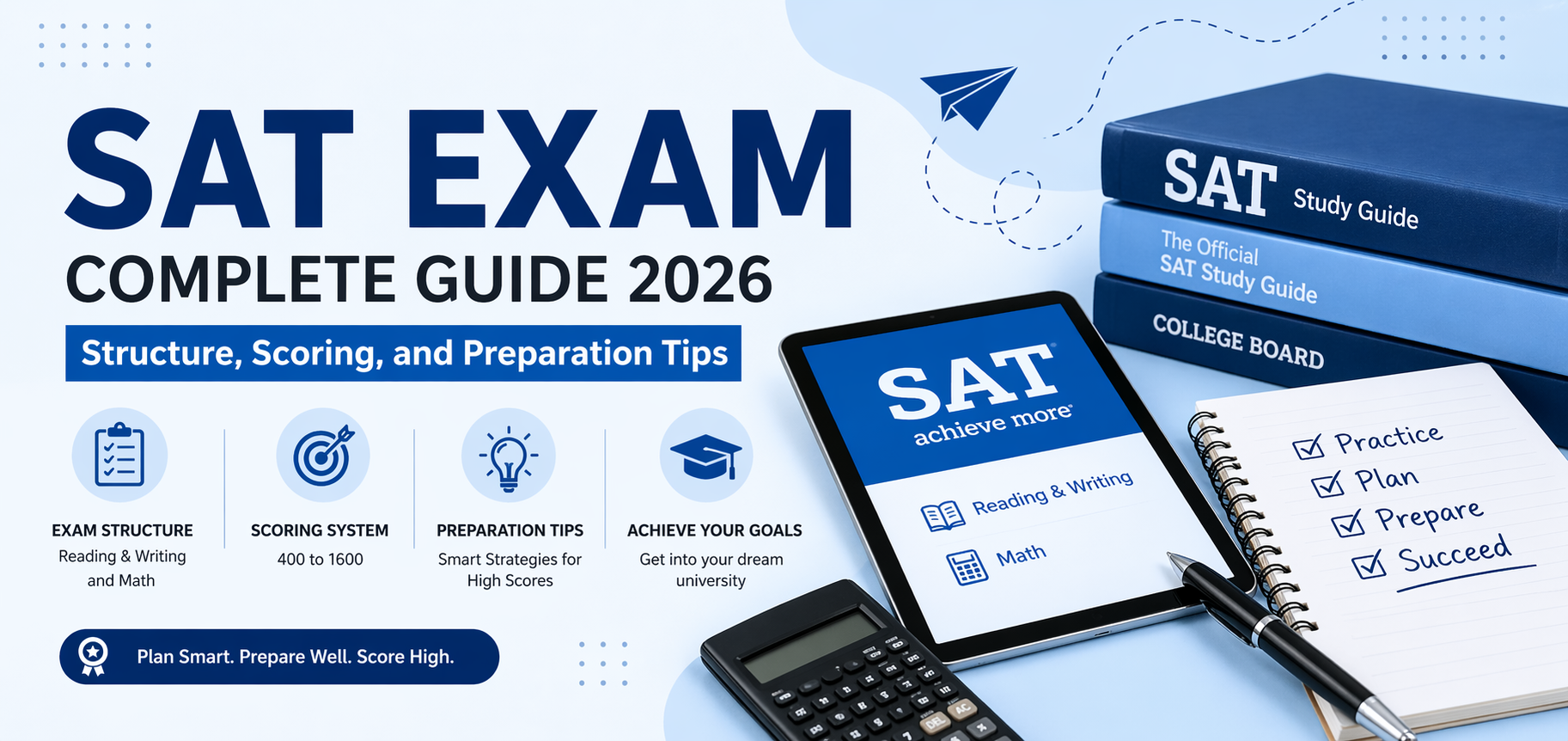
The SAT Exam is one of the most widely recognized standardized tests used for college admissions, especially in the United States. Many universities use SAT scores to evaluate a student's academic readiness and potential for success in higher education.
With the introduction of the Digital SAT, the exam has become shorter, more adaptive, and more student-friendly. If you are planning to apply to universities abroad, understanding the SAT exam structure and preparation strategies is essential.
What is the SAT Exam?
The Scholastic Assessment Test (SAT) is a standardized entrance exam administered by the College Board. It measures a student's proficiency in reading, writing, and mathematics.
SAT scores are accepted by thousands of universities worldwide, including many institutions in the USA, Canada, and other international destinations.
SAT Exam Structure (Digital SAT)
The Digital SAT consists of two main sections:
1. Reading and Writing
This section evaluates your ability to understand and analyze written passages.
Topics include:
- Vocabulary in context
- Grammar and sentence structure
- Reading comprehension
- Editing and improving passages
Duration: ~64 minutes
Questions: 54
2. Math
The Math section measures problem-solving and mathematical reasoning skills.
Topics include:
- Algebra
- Advanced Math
- Problem-solving and data analysis
- Geometry and trigonometry
Duration: ~70 minutes
Questions: 44
Students can use a built-in calculator during the exam.
SAT Scoring System
The SAT score ranges from 400 to 1600.
- Reading & Writing: 200–800
- Math: 200–800
The two section scores are combined to produce the total SAT score.
A score above 1300 is generally considered competitive for many universities.
Why Take the SAT?
Taking the SAT provides several advantages:
- Helps strengthen university applications
- Required by many US universities
- Can increase chances of scholarships
- Provides a standard benchmark for academic ability
Even universities that are test-optional may still consider strong SAT scores positively.
SAT Preparation Tips
Preparing strategically can significantly improve your SAT performance.
1. Understand the Test Format
Familiarize yourself with the structure and question types.
2. Practice with Official Tests
Use official practice exams provided by the College Board.
3. Focus on Weak Areas
Spend extra time improving weaker subjects.
4. Improve Time Management
Practice answering questions quickly and accurately.
5. Take Digital Practice Tests
Since the SAT is now digital, practicing on a computer is important.
When Should You Take the SAT?
Most students take the SAT in Grade 11 or Grade 12. However, it is recommended to take the exam early enough to allow time for retakes if necessary.
SAT exams are offered multiple times per year globally.
Final Thoughts
The SAT exam plays an important role in the college admission process, particularly for students aiming to study abroad. By understanding the exam structure, practicing consistently, and developing strong test strategies, students can achieve competitive scores and open doors to top universities.